

Aesthetic Restorations
Tooth decay is one of the problems that severely affects dental health, and reduces facial features. When one or more teeth are lost, the remaining teeth tend to be deviated.
Loss of teeth is also a risk that affects the bite joint, making the remaining teeth more susceptible to tooth decay, tooth decay, and serious damage to the gum.
Cosmetic Dentistry is an optimum solution for missing teeth and is one of the recommended treatments for dentists.


Aesthetic Restorations
Types of Aesthetic Restorations
- Crown
- Bridge
- Denture
Dental Crowns
A dental crown is like a protective cap placed over a tooth. It helps restore the tooth’s shape, size, strength, and appearance. Crowns can improve both function and aesthetics.
When to Make a Crown
Crowns are recommended in the following situations:
- Tooth decay (cavities)
- Teeth that are chipped, broken, or worn down
- To provide support for a dental bridge
- Teeth that are severely discolored or misshapen
- As implant crowns (placed on dental implants)
Types of Crowns
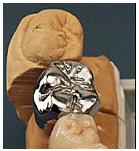
Metal Crown
Crowns can be made of metal, there are many types of metal used, usually Ni-Cr alloy, Cr-Co, Titan, gold alloy (Au) …
Metal-Ceramic Crowns
This type of crown has a metal framework inside, covered with an aesthetic ceramic layer on the outside. It is highly aesthetic because its color and gloss closely resemble natural teeth.
The inner metal framework can be made from different materials such as:
- Chromium-Cobalt (Cr-Co)
- Titanium
- Gold alloy

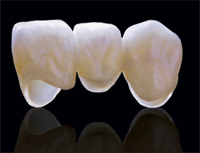
Non-metal porcelain
Aesthetic porcelain crown
Although the porcelain crown has met the aesthetic requirements are quite high, but there are still some defects such as lithium is not quite like real teeth and must have a layer of porcelain to cover metal ribs inside (especially the metal There are more types of aesthetically pleasing porcelain (formerly called non-metallic porcelain but because of the recent appearance of Ziconium as a white metal). Highly durable and durable, so the word aesthetic will be more appropriate.)
Metal-Ceramic Crowns
There are various types of porcelain aesthetics, depending on the specific case of which use appropriate, – Ziconium ribbed porcelain made by CAD / CAM technique like CERCON porcelain

Crap gold
Dental Crowns
Advantages and Disadvantages of Dental Crowns
Gold Crowns
Advantages
- Simple design with fewer complications.
- Minimal removal of tooth structure, preserving more healthy tissue.
- Unlike porcelain crowns, gold crowns do not wear down the opposing teeth during chewing.
- They bond well to the tooth structure.
- Gold is biocompatible and does not cause irritation to gum tissue.
Disadvantages
- Poor aesthetics due to their metallic golden color.
All-Porcelain Crowns
Advantages
- Provide the highest level of aesthetics, closely matching the natural color and translucency of teeth.
- Easy to blend with surrounding teeth for a natural appearance.
Disadvantages
- Require thicker porcelain to achieve strength and aesthetics, which means more tooth structure must be removed.
- Can be more fragile compared to crowns with a metal base.
Metal-Ceramic Crowns
Advantages
- Offer a natural tooth-like color and appearance.
- Strong and durable due to the underlying metal framework.
Disadvantages
- The metal substructure requires an opaque layer beneath the porcelain, which reduces translucency.
- As a result, they may not look as natural as all-porcelain crowns.
Steps for Performing Dental Crowns
Making and completing a crown usually requires two appointments:
1. First Appointment – Consultation, Tooth Preparation, and Impression
- The dentist examines the tooth and may take an X‑ray to check the pulp and surrounding structures.
- If the pulp is infected or damaged, root canal treatment may be required before placing the crown.
- Local anesthesia may be given to reduce sensitivity.
- The tooth is reshaped (reduced) on all surfaces to create space for the crown.
- If the tooth is severely damaged, the dentist may rebuild it with filling material to form a proper base for the crown.
- Once the tooth is prepared, the dentist takes an impression (mold) and sends it to the dental laboratory to fabricate the crown.
- A temporary crown is placed to protect the tooth and maintain aesthetics until the permanent crown is ready.


2. Second Appointment – Crown Placement
- The dentist removes the temporary crown.
- The permanent crown is checked for fit, bite, and color match with the surrounding teeth.
- Adjustments are made if necessary.
Dental Bridges
A bridge is indicated in cases of missing teeth. It is made up of two adjacent teeth that act as supports to hold the artificial tooth (denture) in place. Bridges can be made of metal, porcelain, or gold. They may be supported by natural teeth or by dental implants.
Advantages of Bridges:
- Restore your smile
- Improve chewing and speaking ability
- Help maintain the natural shape of the face
- Distribute chewing forces evenly across teeth
- Prevent neighboring teeth from shifting out of position


Dentures
Dentures are used to replace multiple missing teeth and the surrounding tissues. There are two main types: full dentures and partial dentures.
- Full dentures are used when all teeth in the jaw are missing.
- Partial dentures are used when some natural teeth remain.
Full Dentures
- Replace all missing teeth in the jaw.
- Fit snugly on the gums and are supported by the underlying bone.
Types of Full Dentures:
- Hard acrylic dentures
- Flexible acrylic dentures
Implant-Supported Dentures
These are similar to conventional full dentures but are attached to dental implants. This provides greater stability and firmness, especially during chewing.
Tetracycline Staining
In severe cases of tetracycline‑induced tooth discoloration, there are two main restorative options:
- Full Porcelain Veneers: A thin layer of porcelain is bonded to the front surface of the teeth. This requires minimal tooth reduction and provides good aesthetics, though it is less resistant to heavy chewing forces.
- Porcelain-Fused-to-Metal (PFM) Crowns or All-Porcelain Crowns: These offer stronger coverage and are considered the best solution for severe discoloration, as they completely mask the underlying tooth color.

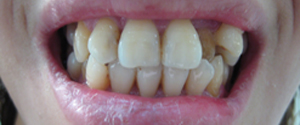
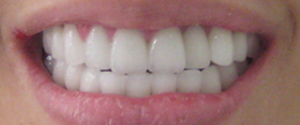
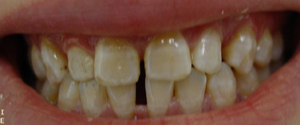
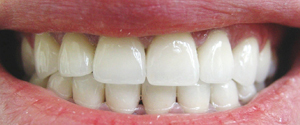
Before and After Dental Restorations: Bridges and Crowns
Before
After
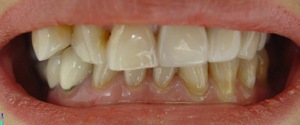
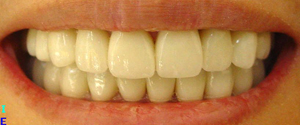
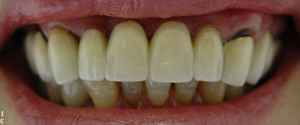
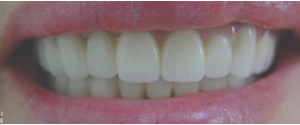
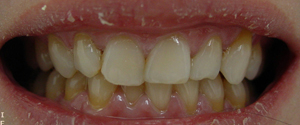
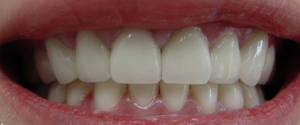
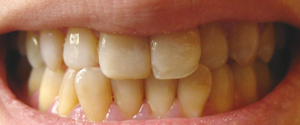
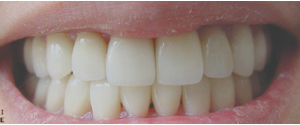
Fequently Asked Questions
Q1: What is Tetracycline Staining?
Answer:
- Tetracycline is an antibiotic. Similar drugs include Doxycycline and Minocycline.
- If taken during pregnancy or by children under 7–8 years old, it can permanently stain teeth.
- Teeth may turn yellow, brown, or gray, sometimes with visible bands.
- Severe cases can cause teeth to look misshapen or defective.
- In Vietnam, this condition is common due to heavy use of tetracycline during wartime.
Q2: What is Fluorosis?
Answer:
- Fluoride is found naturally in water and is added to tap water, milk, and toothpaste to prevent cavities.
- Too much fluoride during pregnancy or childhood can cause brown spots or chalky white patches on teeth.
- Severe cases may weaken the enamel and affect tooth structure.
Q3: What Other Conditions Can Cause Tooth Discoloration?
Answer:
- Blood disorders
- Enamel development problems (enamel hypoplasia)
- Rhesus factor incompatibility between mother and child
Q4: How Do Tetracycline-Stained Teeth Look?
Answer:
- Dark yellow teeth
- Dark gray teeth
- Brown teeth with weak enamel
- Gray‑brown teeth with enamel defects
Q5: How Can Tetracycline Staining Be Treated?
Answer:
- Mild cases: Tooth whitening (bleaching) may help.
- Severe cases: Porcelain restorations (veneers or crowns) are the most effective solution, especially if enamel is damaged.
Q6: What is Cercon?
Answer:
Cercon is a modern dental material made from Zirconium Oxide. It is strong, durable, and safe for gums.
Benefits of Cercon:
- Made with advanced CAD/CAM technology for a perfect fit.
- Extremely strong and long‑lasting.
- Covered with porcelain that looks just like natural teeth.
- No risk of allergies or gum irritation (unlike some metal crowns).
- Resistant to plaque buildup, keeping teeth cleaner.
- Provides a natural, lifelike appearance under all lighting conditions.
